'Best of TBH Politoons'

Baron Dave Romm
Dr. Martin Luther King Jr. Day 2008
By Baron Dave Romm
Shockwave Radio Theater podcasts
Martin Luther King is honored in death more than he was in life
I'm annoyed that the person who is second most responsible for the success of the Civil Rights movement is James Earl Ray. (First is Lee Harvey Oswald.) Dr. King, while he was alive, was revered by many and hated by many more. His honors and successes were nudging a racist nation toward true democracy, yet only in violent death has his dream approached reality.
When the conservative news media talks about "the 60s", they often show a montage of peace symbols, protests, psychedelia and black people rioting. They almost never show the assassinations of JFK, MLK or RFK. The three tragedies jolted a nation, each in their own way, and served as a wake-up call on many fronts.
Hillary Is Right
A statement from Hillary Clinton speaking to why she is running for president, was historically accurate. This non-event has been drastically blown out of proportion by pundits desperate to create conflict where none exists in the Democratic Party. Amongst many sources, the Berkshire (MA) Eagle has a nice take. MLK and LBJ January 20, 2008 (which seems to have disappeared into the archives a mere five hours after it was posted, so I'll quote all of the editorial):
Martin Luther King Jr. Day arrives this year following a tempest over his legacy that briefly marred the Democratic presidential campaign. The controversy revealed a lot about people's prickliness and the manner in which the demands of the 24/7 news cycle can inflate an incident way out of proportion. It also provided an opportunity to reflect on the civil rights era in a manner that should happen every year when the holiday honoring the martyr assassinated 40 years ago this April comes around.
In discussing civil rights, Democratic presidential candidate Hillary Clinton observed that "Dr. King's dream began to be realized when President Lyndon Johnson passed the Civil Rights Act of 1964. It took a president to get it done." The comment could not be much more innocuous, but the second sentence was interpreted by some as demeaning to the efforts of Mr. King. The New York Times referred to the statement as a "gaffe" that could cost Ms. Clinton dearly in her battle with Barack Obama for black voters.
While Mr. Obama said Ms. Clinton's remark was "ill-advised" and "unfortunate," he was following the controversy, not leading it. John Edwards' conclusion that Ms. Clinton said it took a "Washington politician" to bring about change fit in well with his campaign of angry populism, but he misinterpreted Ms. Clinton and was unfair to President Johnson. Last week, Ms. Clinton, Mr. Obama and Mr. Edwards declared an end to the dispute before their debate in Nevada, and not a moment too soon. The needless controversy was threatening to drive a wedge in a Democratic Party that has three presidential candidates with fine minority rights credentials.
It would be easy to get the impression from the brouhaha that Mr. King and President Johnson moved in separate worlds, one battling for civil rights on the streets of America, the other fighting the good fight in Washington. In fact, each knew that he needed the help of the other and they worked together for their common goals.
LBJ needed Mr. King's assistance to gain support for his landmark Civil Rights Act of 1964, and Mr. King needed LBJ's backing in getting passage of voting rights bills and other civil rights legislation. The president provided federal protection for Mr. King when he and his supporters marched in the South, including states like Alabama where Governor George C. Wallace sent his troops after the protesters. The charismatic Mr. King was able to help persuade the media to consider the president's civil rights initiatives. It is likely that Mr. King would agree with Ms. Clinton's contention that "It took a president to get it done," and LBJ would surely have acknowledged that without the courage and eloquence of Mr. King, there would have been little support in the nation or Washington for the civil rights laws and the succeeding laws that, to paraphrase Ms. Clinton, got it done. Together they changed America forever, and for the better.
On "Meet the Press" in the heart of the controversy, Ms. Clinton observed: "Does he (Martin Luther King) deserve the lion's share of the credit for moving our country and moving our political process? Yes, he does. But he also had partners who were in the political system." Thankfully, this election year is not likely to be as volatile as was 1968, but it has the potential to be a transforming year, just as 1968 was. America could use brave visionaries like Martin Luther King and politicians like LBJ who, his Vietnam disaster aside, wasn't afraid to reach out to those who needed a helping hand from their government.
Hillary was exactly right: Once King had galvanized enough people to act, LBJ (and Hubert Humphrey and many brave Congressmen) had to pass legislation to make the dream come true.
King, LBJ worked together to change the nation There was no going it alone in pushing civil rights and the social revolution that remade America. Houston Chronicle, January 19, 2008:
The greatest fairy tale of the 2008 campaign so far is the accusation that there is some tint of racism or putdown of Martin Luther King Jr. in Hillary Clinton's comment that "it took a president," Lyndon Johnson, to realize the civil rights leader's dreams.
The visionary preacher and the tough-talking master politician would be the first to say that they needed each other. I know how they came to work together, in a complex partnership, to produce a social revolution that has saved this nation.
Just days after President Kennedy's assassination, King was pressing LBJ on civil rights. In conversations with Johnson, King made clear his willingness to seek out dramatic confrontations in the Deep South and to risk his safety if necessary to get government action. He knew it would take presidential leadership, he said, and he shrewdly held out the potential of supporting Johnson in the 1964 campaign.
LBJ appreciated King's powers of persuasion and ability to attract media attention. He decided to "shove my stack of chips into the pot" to push for passage of the 1964 Civil Rights Act, which outlawed discrimination in education, employment and public accommodations. To break a filibuster, Johnson had California Democrat Clair Engle, who was dying of a brain tumor, wheeled onto the Senate floor. Engle couldn't speak, so LBJ had him signal his aye vote by pointing to his eye.
The day after passage, Johnson told his aide Bill Moyers, "I think we delivered the South to the Republican Party for your lifetime and mine." Indeed, he was defeated in five Southern states in 1964, four of them states Democrats had not lost in more than 80 years. The losses didn't faze him, and he turned his energies to voting rights for black Americans.
Johnson met with King on Feb. 9, 1965, about his campaign to register voters in Alabama. As a politician preparing to press a voting rights bill, LBJ loved King's choice of Selma. Dallas County Alabama's population was 60 percent black; most of its voting-age population was black, but only 335 out of 10,000 registered voters were black.
Voters could register only two days a month and had to complete a form with more than 50 blanks, write passages from the Constitution and answer complex questions about the U.S. government.
King urged Johnson to propose voting rights legislation, and LBJ said that he would soon and that he thought the pressure of a march would help. Johnson was appalled when state troopers used clubs and whips to halt the march from Selma to Montgomery, even killing some protesters, and he blamed Alabama Gov. George Wallace, whom he called "a runty little bastard, just about the most dangerous person around."
Sensing the awakening public sentiment, Johnson gave one of his most powerful speeches on March 15. He proposed his voting rights act to a joint session of Congress and, in closing, slowly intoned the battle hymn of the civil rights movement, "And we shall overcome." For a moment the chamber was frozen. Then almost everyone rose in thunderous applause.
King knew that the march was essential to keep the heat on. He began again on March 22, this time with federal protection. Thanks to the Army presence, there was no serious violence.
Later, on his way to sign the act, Johnson spoke to staffers of "a new day in America, if, if, if," he said, "the Negro leaders get their people to register and vote." He signed the bill in the Capitol room where, 104 years earlier, Abraham Lincoln had signed a bill freeing slaves who had been pressed into Confederate military service. Johnson gave the first pens to key legislators and then gave one to King. He urged King and other rights leaders to shift their energies "from protest to politics."
In 1966, Johnson's attention turned to the Fair Housing Act, which prompted the most vicious mail LBJ received on any subject. When King went north to push for fair housing, he said he had "never seen such hate - not in Mississippi or Alabama - as I see here in Chicago." Sadly, this turned out to be their last joint achievement.
By March 1968 there was still no hope of passage in the House. The morning after King was assassinated, President Johnson called me into his office and said, "At least we're going to get our fair housing bill. I'm asking the speaker (John McCormack) and minority leader (Gerald Ford) to pass the Senate bill today." He worked the phones, citing this as a last tribute to King. Days later, the House passed the bill.
Enacting these laws took both the civil rights leader and the "Washington politician" whom John Edwards has derided in attacking Hillary Clinton. And both of them knew it. With the 1964 and 1965 civil rights acts, King told Johnson, "You have created a second emancipation." The president replied, "The real hero is the American Negro." That's an example the presidential candidates and civil rights leaders of 2008 would be wise to follow.
The economic expansion during the Reagan administration could never have happened without the Civil Rights movement
The Free Speech Movement starting in the 50s. The feminist movement had long historical roots but didn't take off until The Pill was introduced in 1960. The Civil Rights movement spawned by the Greatest Generation where all races fought side-by-side (more or less) led to legal victories such as Brown vs. Board of Education, the 24th Amendment outlawing the Poll Tax, the Civil Rights Act of 1964 and the National Voting Act of 1965. These related but separate movements found common ground fighting the Vietnam War. Each a minority thread, they came together under the Anti-War political umbrella.
One of the major consequences of these (and other) cultural awakenings was the equal opportunity for a college education -- a good, comparable, education -- for women, blacks, and others who might not have afforded the cost or who might have been turned away based solely on the biases of the the school administrators. By the 1980s, a much larger pool of experienced managers, technicians, programmers and entrepreneurs could take advantage of the expansion of the Federal Government, fueled by red ink, that poured into the economy under Reagan, and could handle the new computer technology that the old guard largely didn't understand.
Martin Luther King was a major part of changing America for the better. As an orator, he commanded attention, and people rallied around his words as well as his deeds. Today, he would have a popular blog and his live speeches would be on YouTube. In his time, with very few exceptions, you had to be there. TV coverage was spotty at best. His Nobel Peace Prize acceptance speech from December 10, 1964 was preserved but not recorded.
King's Assassination pushed the issue to the forefront
The marches had been marched, the riots quelled, the laws passed. But even by the 1968, at the height of the anti-war movement and the beginning of the rising tide of the true American Dream for all, too many were part of Nixon's Silent Majority, the range of people who either didn't give a damn one way or another, or, like the Isolationists pre-WWII who wanted to leave Hitler alone, were unabashedly racist, anti-semitic and sexist.
The Assassination of Dr. Martin Luther King, Jr. on April 4, 1968, was a shock. At age 39, he had been an influential spokesman and rising star on the national and international scene. "But it's getting better for them!" I heard (in so many words) many times. The middle America white fo'k (us) were happy, for them, at least on the surface.
Personal note: I was not-quite-13, having been Bar Mitzvah'd five days earlier. We lived in a very conservative county, just down the road from West Point. Our part of New York State was not directly affected by the riots, but the impact was felt by our small town community. I don't remember much in the way of specifics, but I remember the shock and shame that such a thing could happen here.
Riots ensued, less directed and perhaps less angry than the riots just a few years earlier. Taking it to the streets seemed, to me at the time, more a product of existential angst than of cultural inequality. Programs in the works were hurried through, streets were named for the fallen orator, and the Civil Rights Movement had a martyr. A famous martyr, rather than the brave unknowns who fought and died in the decades earlier. We will never know what Dr. King might have gone on to be. He could have been a more credible Jesse Jackson or a sane Al Sharpton. His voice was silenced early, but his death showed the country that merely passing laws was not enough.
(As if to prove that right wing nutjobs were equal opportunity assassins, anti-war presidential candidate Bobby Kennedy was shot two months later.)
Racism still drives the American right
In the forty years since Dr. King's assassination, much progress has been made. Barack Obama is a leading presidential candidate (not just "a candidate"). Blacks are represented in the entertainment media. (In April 1968, how many blacks were stars of tv shows? Offhand, I can think of only two: Bill Cosby of I Spy and Nichelle Nichol of Star Trek. Julia didn't start until the fall of 1968.) Two black head coaches met in the Superbowl. "The Race Card" is played (or is claimed to be played by right-wing media elites) anytime race is mentioned, rather than any attempt to introduce civil rights legislation. And so on.
LBJ was right: passing the Civil Rights and Voting Rights acts gave the South to the Republican Party. The George Wallace branch of the Democrats became the David Duke/Pat Buchanan branch of the GOP. "Law and Order" and "Social Conservatives" were the code words for many (though not all) racist candidates.
The racial divide may be shrinking, but as their numbers get smaller the Christian Jihadists come out of the woodwork. Hark Aaron was subject to much scatological hatemongering as he pursued (and eventually beat) Babe Ruth's home run record. Larry Flynt was shot by White Supremacist Joseph Paul Franklin in 1980 not because he published porn, but because he published pictures of sex between a white person and a black person. For this, he is revered by racists today as One of the true unsung heroes in movement history. Even today, attacks on the Great Society reforms seem less about individual rights as they are attempts to dismantle the legal protection for minorities. Left to their own devices, the far right will demean black quarterbacks and wax nostalgic for the day when Jim Crow ruled.
The fact that "the race card" can be successfully played, even when it wasn't, in 2008 shows how far we have come since Dr. Martin Luther King Jr. was around to cajole and inspire a nation and a world. Today, we celebrate his birthday in typical American fashion: On the wrong day. He was born on January 15, 1929, but it is far more convenient to have the Federal Holiday on a Monday. So be it. On this day we honor his memory, and by extension we honor all those who fought and continue to fight for the American Ideal.
Starting a tradition
MLK Day does not have long tradtions of picnics or fireworks or parades. If they do anything, people read his speeches and reflect on his times. This is fine, as far as it goes, but I would like to start a tradition, beginning today:
Go to a racist/conservative blog or website. Post, in your own words or by quoting Dr. King, why America is a stronger nation when we all pull together, and when all citizens are equal under the law. Don't be inflamatory and for god's sake don't sink to their level. Ignore the worst responses and, if you desire, engage the reasonable people. Yes, there are reasonable people on the right. Use your example to cajole and inspire.
We have rhetorical tools Dr. King could not dream of. Let's use them to spread his word.
Baron Dave Romm is a conceptual artist and a noble of Ladonia who produces Shockwave Radio Theater, writes in a Live Journal demi-blog, plays with a very weird CD collection and an ever growing list of political links. Dave Romm reviews things at random for obscure web sites. You can read all his music recommendations from Bartcop-E. Podcasts of Shockwave Radio Theater. Permanent archive. More radio programs, interviews and science fiction humor plays can be accessed on the Shockwave Radio audio page.
Thanks to everyone who has sent me music to play on the air.
--////
Recommended Reading
from Bruce
Will Durst: The GOP Candidates' Love Affair with Reagan
The GOP could roll into their National Convention with an entire starting basketball team of prospective candidates posing as Ronald Reagan.
Paradise regained (telegraph.co.uk)
Author Philip Pullman champions a new brand of environmentalism that offers hope for us all.
Will Lawrence: Little Miss Weird Ricci wises up (timesonline.co.uk)
As a teen starlet she had a history of anorexia and self-harm; but Christina Ricci is older and smarter now.
Duffy, aka 'the new GEORGE SCIALABB: A Great Deal of Work (thenation.com)
Edmund Wilson's temperament and critical method - curious, energetic, humane, and intelligent - still have their appeal...
Richard Roeper: A low point for higher education (suntimes.com)
I'm not sure what's more disturbing: "hardcore midget wrestling" at a Northwestern University frat party, or a mental midget feted by the Harvard Lampoon.
Greg Beato: Hannah Montana's Body Double Raises Critical Questions (lasvegasweekly.com)
Is Miley Cyrus a fraud -- Hannah Nontana, Hannah Faketana or Miley Vanilli, as internet hecklers have taken to calling her? Or is she just impressively committed to wardrobe diversity?
Walter Tunis: Emmylou Harris, Shawn Colvin & Patty Griffin have a Buddy (McClatchy Newspapers; Posted on popmatters.com)
He's more than their collaborator, their guitar voice or their harmonizer. As the title of their joint January tour suggests, Emmylou Harris, Patty Griffin and Shawn Colvin share a common fondness for their Buddy.
Roger Moore: Julian Schnabel says he's made a film everyone can relate to (The Orlando Sentinel; Posted on popmatters.com)
Julian Schnabel sees a different world than the rest of us. That was obvious from his paintings, "bold, confrontational" pieces of neo-expressionism, the critics raved as he rose to fame in the 1970s and `80s.
The Percy Anecdotes: Anecdotes of Music
Claude le Jeune, when at the wedding of the Duc de Joyeuse, in 1581, caused a spirited air to be sung, which so animated a gentleman present, that he clapped his hand upon his sword, and said it was impossible for him to refrain from fighting the first person he met; upon this, Le Jeune caused another air to be performed, of a more soothing kind, which soon restored him to his natural goodhumour.
Roger Ebert: Answer Man
Jim's real problem is that Juno doesn't like the same music he likes. I know how he feels. If only these damn kids would listen to the critics, they'd like what we like. His other problem is that real teens don't talk like Juno. Real 16-year-old rock critics don't talk like the Patrick Fugit character in "Almost Famous," either. In short: Movie characters don't talk like real people. If they did, they'd drive us nuts.

Selected Readings
from that Mad Cat, JD

In The Chaos Household
Last Night
Mostly sunny but a lot cooler.

Rides To The Rescue
Elton John
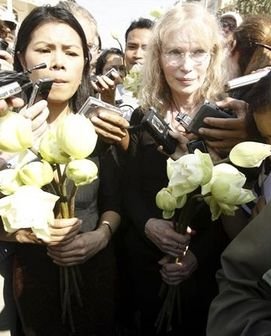
Veteran British pop star Elton John has donated 120 motorbikes to help doctors and nurses do their rounds in the mountainous southern African kingdom of Lesotho.
John, accompanied by his partner David Furnish, took time out on Saturday from a tour of South Africa to visit Lesotho for the handover ceremony just outside the capital Maseru.
The donation forms part of the Riders for Health Programme funded by the singer's own AIDS foundation.
"We want to improve the transport system by bringing health care to millions of people living in the most rural areas and thus making a difference in their lives," said John in comments reported by local media.
Elton John
New Marker For Texas Home
Janis Joplin
Janis Joplin's laugh still rings in the memory of a childhood friend.
At a gathering to dedicate a historic marker in front of one of the singer's childhood homes, Monteel Copple recalled her friend's laugh as they tried to keep their skirts in place while hanging upside down on the school's monkey bars.
Saturday would have been Joplin's 65th birthday. She died of a drug overdose on Oct. 4, 1970.
Joplin was 4 when her family moved into the house that now has the marker. The family moved out in 1975. Her first childhood home was torn down in 1980.
Janis Joplin
Kansans Tell Holocaust Hero's Story
Irena Sendler
It was just an old clip from a magazine with a list of names that several students had dismissed as too obscure, too hard to research.
But, somehow, in 1999 when it got into the hands of a few teenage girls from rural southeast Kansas, that little clip started changing lives. It also gave those girls - now women - good reason to watch closely as last year's Nobel Peace Prize was announced.
On the clip were names of Holocaust heroes, one of whom caught the students' attention. Irena Sendler, it said, helped rescue 2,500 children from the Warsaw ghetto during the Holocaust more than 60 years ago.
"We thought maybe it was a typo," said Megan Felt, who was a freshman that year and read the clip along with Sabrina Murphy and Elizabeth Cambers Hutton. "Even Oskar Schindler saved only about 1,000 Jews, and he was really well known."
Irena Sendler

Compared To Goebbels
Tom Cruise
Respected German historian Guido Knopp has compared a speech by US actor Tom Cruise to the Church of Scientology with a call to war by Nazi propaganda minister Joseph Goebbels.
Knopp, an expert on World War II history, said in an interview with Bild newspaper published on Sunday: "Tom Cruise's manner calls to mind Goebbels." The historian was commenting on a video recording of a rousing sermon Cruise delivered to fellow Scientology members four years ago that was recently posted on the Internet.
The "Mission Impossible" star is seen asking fellow members of the church: "Should we clean this place up?" Knopp said it was bound to remind Germans of Goebbels' notorious call for "total war" issued in Berlin on February 18, 1943.
"It is possible that the way in which Cruise speaks is common in many empowerment circles in the United States," he said. "But the scene in which Cruise asks if the Scientologists should clean up the world and they all respond 'yes' will remind any German with an interest in history of Goebbels' infamous Sports Palace speech."
Tom Cruise
Reuben's In Florida
Dave Madden
There was a time in the early 1980s when Dave Madden tried to take his two young children to Disneyland and found himself so mobbed by autograph seekers that he had to leave.
By then the run of four seasons in prime time for The Partridge Family was almost a decade past. But the show about a fictional family of pop singers lived on in reruns.
Madden, then a middle-age comedian and actor who had played the band's curmudgeon of a manager, Reuben Kincaid, had in the words of TV critic David Bianculli "emerged as some sort of mini-icon for the X-Generation, like some bell-bottomed Barney Fife."
When he speaks, he's still instantly recognizable as the put-upon band manager who served - and sometimes still serves - as verbal sparring partner to Danny Partridge, a.k.a. Danny Bonaduce.
Dave Madden
Prompting Early Obits
Young Celebrities
It's never been a secret that when people die after long and distinguished careers, those detailed stories about their passing that major news organizations seem to produce almost instantaneously in fact were written well in advance.
Now news that The Associated Press has prepared an obituary for 26-year-old Britney Spears has put the spotlight on a debate transpiring within the business of reporting death: With people grabbing the celebrity spotlight at a younger age, and some of them living lives of obviously dangerous excess, is it time for news organizations to begin preparing for early exits from celebritydom's under-30 crowd?
Of the approximately 100 prepared obituaries The Washington Post has in its files, reporter Adam Bernstein couldn't recall any on a person under 30. He also questioned whether an obituary on someone like the troubled pop star could be much more than a recitation of bizarre public behavior, as opposed to focusing on real accomplishment.
Young Celebrities
Our Allies Justice
Forced Annulment
Two years ago, a knock on Fatima and Mansour al-Timani's door shattered the life they had built together.
It was the police, delivering news that a judge had annulled their marriage in absentia after some of Fatima's relatives sought the divorce on grounds she had married beneath her.
That was just the beginning of an ordeal for a couple who - under Saudi Arabia's strict segregation rules - can no longer live together. They sued to reverse the ruling, publicized their story and sought help from a Saudi human rights group.
But the two remain apart and Fatima said she is considering suicide if her recent appeal to King Abdullah does not reunite her with her husband.
Forced Annulment
Airport Offers Live Music
Nashville
Members of the audience dash off suddenly during his show. Others talk on cell phones, read novels or wolf down sandwiches.
John Bontempi takes it all in stride. He strums his guitar and sings another tune near the clanking baggage carousel at Nashville International Airport.
Bontempi is among the 90 or so professional musicians who perform at the airport in its push to add "local flavor," a break from the chain gift shops and restaurants in airports from Miami to Seattle.
In Nashville, the airport began offering music in the early '90s as country was hitting a growth spurt. Today, musicians of every stripe play its five stages most days of the week.
Nashville

Weekend Box Office
'Cloverfield'
The creature-feature "Cloverfield" became the first monster hit released in 2008, debuting with $41 million, a record opening for January, according to studio estimates Sunday.
Paramount's tale of a giant reptile causing chaos in New York City surpassed the $35.9 million premiere weekend of the "Star Wars" special edition in 1997, the previous best for January.
Estimated ticket sales for Friday through Sunday at U.S. and Canadian theaters, according to Media By Numbers LLC. Final figures will be released Tuesday.
1. "Cloverfield," $41 million.
2. "27 Dresses," $22.4 million.
3. "The Bucket List," $15.2 million.
4. "Juno," $10.3 million.
5. "National Treasure: Book of Secrets," $8.1 million.
6. "First Sunday," $7.8 million.
7. "Mad Money," $7.7 million.
8. "Alvin and the Chipmunks," $7 million.
9. "I Am Legend," $5.1 million.
10. "Atonement," $4.8 million.
'Cloverfield'
In Memory
John Stewart
John Stewart recorded some of pop music's most acclaimed solo albums, helping create a style that came to be called Americana, but he was always best known for writing the Monkees' enduring hit "Daydream Believer."
Stewart, who came to prominence in the 1960s as a member of folk music's Kingston Trio, died Saturday at a San Diego hospital after suffering a brain aneurism. He was 68.
Stewart left the Kingston Trio shortly before the Monkees released "Daydream Believer" in 1967, then went on to record nearly four dozen solo albums, including the critically acclaimed "California Bloodlines" and "Bombs Away Dream Babies." The latter included the hit single "Gold," in which he dueted with Fleetwood Mac's Stevie Nicks.
Still, as with "Daydream Believer," he was likely best known for writing songs for others, including Joan Baez, Nanci Griffith, Roseanne Cash and Anne Murray.
He wrote "Runaway Train," a country hit for Roseanne Cash, and "Strange Rivers," which Joan Baez included on her 1992 "Play Me Backwards" album. Nanci Griffith dueted with him on "Sweet Dreams" and Murray, like the Monkees before her, had a hit with "Daydream Believer."
He eventually recorded more than 40 solo albums. Others included "The Lonesome Picker Rides Again, "Airdream Believer" and "Rough Sketches," the latter a collection of songs about the iconic American highway "Route 66."
Stewart's wife, Buffy, and children were at his side when he died, according to a statement on the Kingston Trio's Web site. There was no immediate word on funeral arrangements.
John Stewart
In Memory
Andy Palacio
Belizean musician Andy Palacio, who brought the world the music of the Garifuna people descended from Central American natives and shipwrecked African slaves, has died aged 47.
Palacio was one of the world's most prominent defenders of the unique Garifuna culture and language. His band "The Garifuna Collective," played an upbeat dance music called Punta Rock, based on traditional Garifuna rhythms and infused with synthetic beats and keyboards.
He died on Saturday after a series of massive strokes, a heart attack and respiratory failure. He will be buried next week in the coastal village of Barranco where he was born.
Palacio toured the world last year promoting his album "Watina," which won international accolades. UNESCO named him an "Artist of Peace" for his work promoting Garifuna traditions.
Descendants of Arawak Indians and African slaves who were shipwrecked near a Caribbean island in 1635, the Garifuna were deported to Honduras in 1797 by the British. They soon spread to the coasts of Belize, Guatemala and Nicaragua.
Andy Palacio

| CURRENT MOON lunar phases |